Slab Foundation Building Camarillo CA
We pour properly graded, reinforced concrete slab foundations in Camarillo, CA that give your structure a solid, stable base built to last.
Why Getting the Foundation Right Is Everything
Everything built above ground depends on what is underneath it. A slab foundation is not just a floor, it is the structural starting point for your entire project. Whether you are building a new home, adding an accessory dwelling unit, constructing a garage, or installing a shed, the quality of the foundation determines whether that structure stays level, dry, and stable for the next several decades.
Slab foundations are one of the most common foundation types in Southern California for good reason. They work exceptionally well in climates like Camarillo, CA where soil does not experience the freeze-thaw cycles that can heave and crack deeper foundation types. They are also efficient to build, cost-effective compared to crawl space and basement foundations, and when poured correctly, they are extremely durable.
The word "correctly" carries a lot of weight there. A slab that was poured over improperly prepared soil, without adequate reinforcement, or without proper drainage planning is a problem waiting to happen. We have seen it many times. The slab cracks, settles unevenly, or allows moisture to migrate up into the structure above. That is why the preparation work before any pour is the most important part of the job.
What Happens Before We Pour Your Foundation
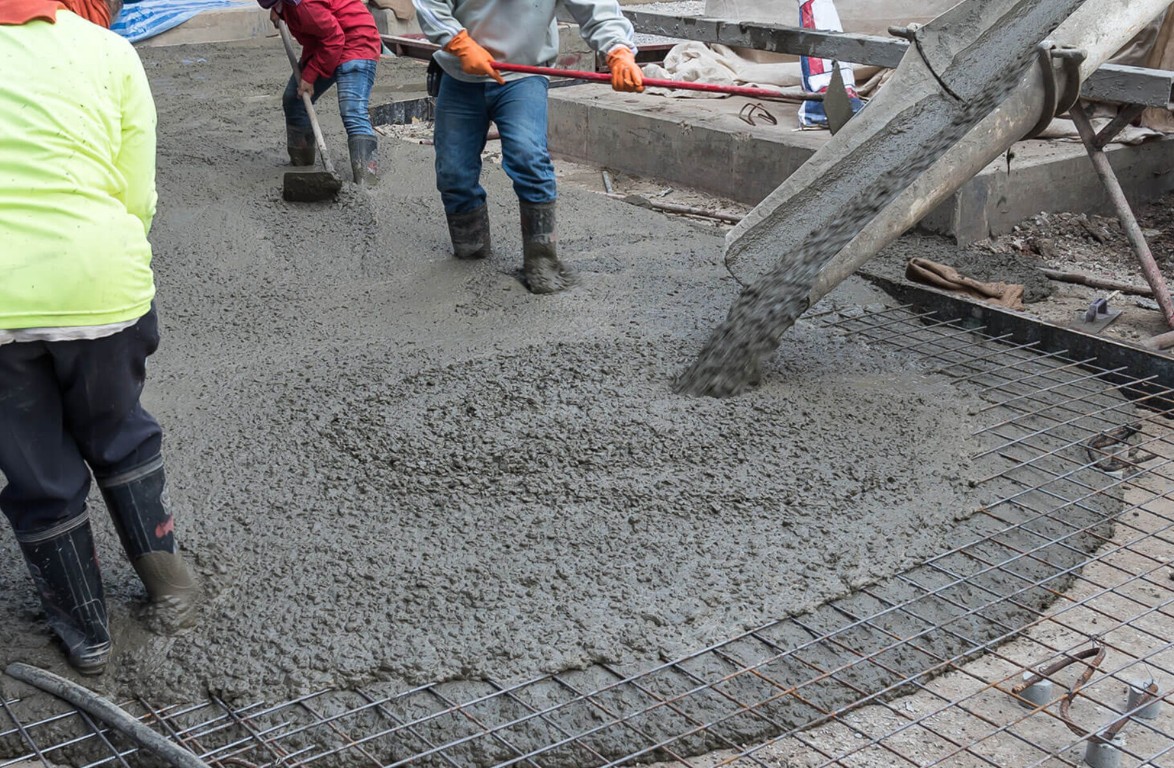
The pour itself is a relatively short part of the overall project. Most of the critical work happens in the days leading up to it. Here is how we approach every slab foundation build:
- Site evaluation and soil assessment: We assess the soil type and condition to determine how much preparation is needed and whether any special engineering is required.
- Excavation and grading: We excavate to the required depth and grade the area to ensure proper drainage. Water management around a slab is critical to long-term performance.
- Compacted base layer: A layer of compacted gravel is placed beneath the slab to provide a stable, well-draining sub-base that prevents differential settling over time.
- Vapor barrier installation: A plastic moisture barrier is placed over the base layer to prevent ground moisture from migrating up through the slab into your structure.
- Rebar placement and tying: Steel reinforcing bar is laid out and tied in a grid pattern according to the project specifications. The rebar gives the slab tensile strength so it can handle loads without cracking.
- Form setting: Perimeter forms define the exact boundaries and thickness of the pour. Proper form setting ensures straight edges and a uniform slab depth throughout.
Once all of this is in place, we are ready to bring in the concrete. We use the appropriate mix design for the structural requirements of your project, typically 3,000 to 4,000 PSI for residential slabs, and we work quickly and methodically to pour, spread, vibrate, and finish the slab before it begins to set.
What Types of Projects Use Slab Foundations?
Slab foundations are used across a wide range of construction types in Camarillo and throughout Ventura County. The most common projects we pour slabs for include:
New home construction and additions are among the most common. A slab foundation for a home addition needs to match the height and drainage profile of the existing structure, which requires precise planning and experienced execution. We take the time to get those details right so your addition feels like a seamless part of the original structure.
Detached garages, workshops, and ADUs are another frequent application. These smaller structures still require a properly reinforced slab that can handle vehicle weight if applicable and remain stable over the decades ahead. We also pour slabs for outdoor workshops, storage buildings, and equipment pads where a level, durable base is needed.
Commercial projects including small retail spaces, warehouses, and light industrial buildings also rely on slab foundations. For commercial applications, we work from engineered drawings and coordinate with inspectors throughout the process to ensure everything meets local building codes.
Whatever your project, a well-built slab gives you a strong start. If you are also planning surface work above the slab, we handle garage floor concrete finishes and can also help with your concrete driveway to complete the project in one coordinated effort.
Questions About Slab Foundation Building
How thick does a residential slab foundation need to be?
Do slab foundations have drainage or plumbing run through them?
How long does a slab foundation take to cure before building on it?
Start Your Foundation Project the Right Way
Call us to talk through your project and get a free on-site estimate. We work on residential and commercial slab foundations throughout Camarillo and Ventura County. See all of our work on the Camarillo Concrete Company home page.